
ByteDance markets Seedream 5.0 Pro on a stack of bold claims: photographic visual quality, high-density infographics, native multilingual generation, interactive editing, and more. We put those claims through a blind tournament. The biggest one held: Seedream beat every rival at photorealistic generation with a 35.7% win rate and finished first or second in 57% of its tournaments. The infographics claim did not: ChatGPT Images 2.0 took that category at 58.6% on its way to the most tournament wins overall.

Ten real-world briefs, four models. Seedream 5.0 Pro, ChatGPT Images 2.0, Nano Banana Pro, and Flux 2 spanning four of the capabilities ByteDance puts front and center for Seedream: photorealistic generation, typography, stylized images, and infographics with complex layouts. Every output was judged blind by working creative professionals.
A tale of four categories
Across all tournaments, ChatGPT Images 2.0 took first place most often at 35.9%, with Nano Banana Pro at 28.6% and Seedream 5.0 Pro just behind at 28.0%. But the overall number flattens the real story: Seedream's results split cleanly along the four categories we tested. It took photorealistic generation outright, ran a close second in typography, and gave back those gains in stylized images and infographics.
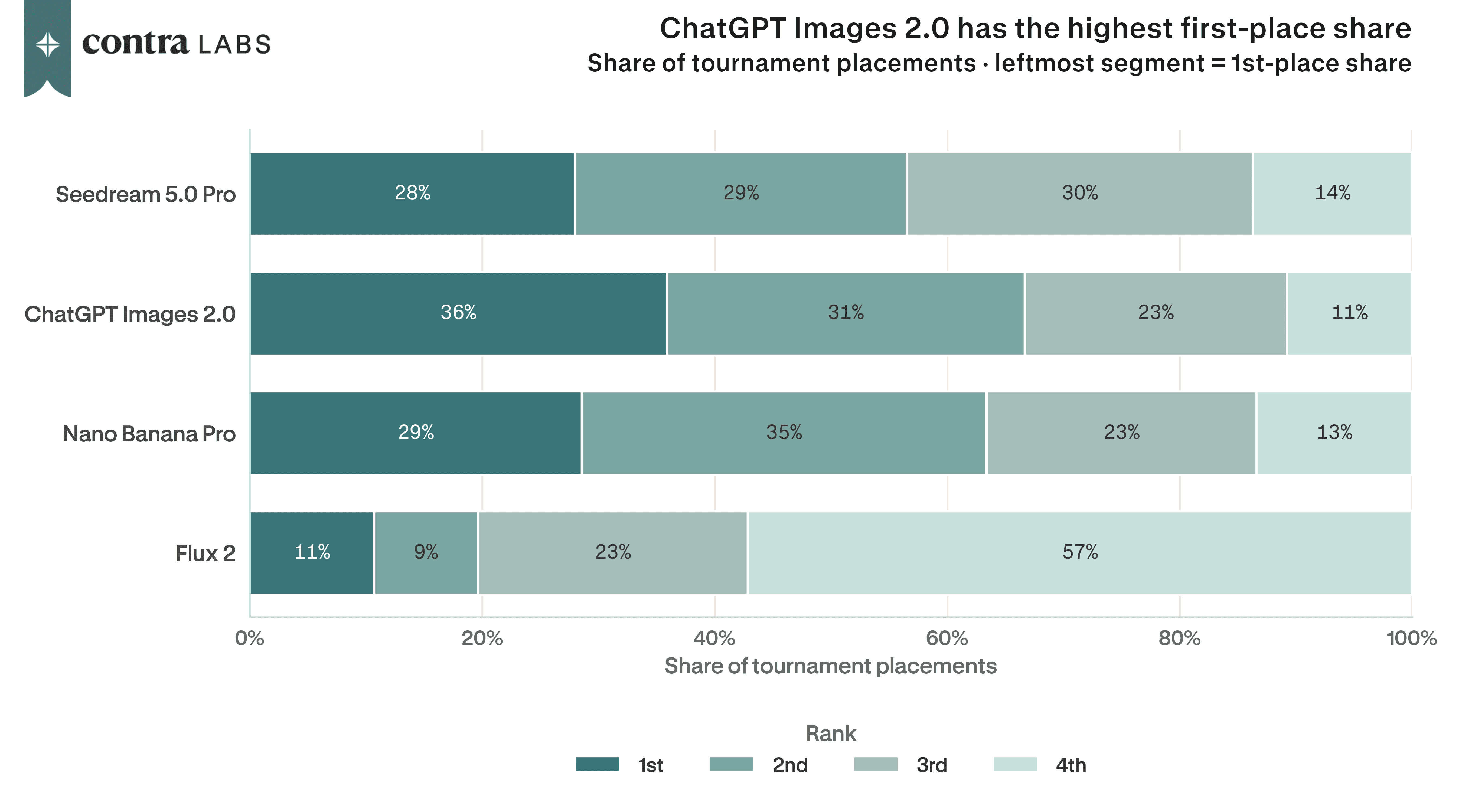
Seedream's finishes spread almost evenly across first, second, and third (28%, 29%, 30%), the flattest profile in the field: where it lands depends on the brief, not on luck. Hand it a photorealism prompt and it sits at the top of the ranking; hand it an infographic and it slides toward the bottom. Its floor stayed high either way, finishing last in just 14% of rankings, while Flux 2 fell through that floor in 57% of its own.
Where Seedream won: photorealism and typography
Seedream took the photorealistic generation category outright with a 35.7% win rate, more than 11 points ahead of ChatGPT Images 2.0 (24.3%). It also ran a close second in typography (32.4% vs. Nano Banana Pro's 35.7%).

When reviewers picked Seedream, the most common reasons were prompt fit (44 comments), composition (33), and visual quality (29). On a macro portrait brief, one reviewer chose it for having:
the best overall balance of sharp iris and eyebrow focus, natural skin texture, and cinematic golden lighting.
The prompt-fit strength extended beyond photorealism to structured, specification-heavy briefs. On a 16-panel film storyboard, Seedream swept multiple reviewers by simply not missing anything:
I chose Model H [Seedream] because it gets the needed job done without any mistakes. It gets the grid layout, numbering, storyboard style, and variety of shots right, and each panel feels different while still keeping a consistent visual language throughout.
On an action-sports selfie brief, it stole the show, with users noting it felt more dramatic and more dynamic than its competitors

Where it fell short: stylized images and infographics
In stylized images, Seedream placed third at 24.4%, well behind Nano Banana Pro's 40.7%. On a motion-blur fashion brief, one reviewer summed up the gap: "Model H [Seedream] looks less realistic, and the effect is a bit off. The lighting and depth are great though."

The heavier losses came in infographics and complex layouts, where ChatGPT Images 2.0 dominated the category at 58.6% and won the two hardest briefs, a technical engineering sheet and an annotated product poster, at 80% each. The recurring failure mode was precision, not aesthetics. On the product poster:

The second recurring critique cuts against intuition for a model that won the photorealism category: when the brief called for documentary authenticity, reviewers found Seedream's output too polished. On a bookstore photography brief:
Model B [ChatGPT] looks like it was captured with an actual phone camera, compared to Model H [Seedream] which had more 'AI Generated - Perfection.'
Even in losses, reviewers kept crediting Seedream's fundamentals. The critique data mirrors the praise data: prompt fit (23 comments), visual quality (16), and composition (10) top both lists, meaning most matchups were decided on execution details between strong outputs.

The bottom line
ChatGPT Images 2.0 won this field, powered by a commanding lead in infographics and near-flawless precision on annotation-heavy briefs. But Seedream 5.0 Pro is the model that most consistently threatened it: neck and neck with Nano Banana Pro on win rate, first or second in 57% of its tournaments, and the outright winner in photorealistic generation. Reviewers who picked Seedream praised its prompt adherence, composition, and cinematic lighting. Reviewers who picked a rival usually pointed to one of two things: small precision misses on text and labels, or a finish so clean it read as AI-made. For teams generating photorealistic hero images, Seedream is a first-choice pick. For text-dense layout work, ChatGPT Images 2.0 remains the safer default.
Methodology
Ten creative professionals sourced from Contra's top-earning talent evaluated ten briefs spanning the four capabilities ByteDance advertises for Seedream: photorealistic generation, typography, stylized images, and infographics with complex layouts. Each brief specified requirements in professional detail (lighting, composition, materials, labels, and layout structure), forcing each model to execute a specification rather than a generic aesthetic. Every brief was run through all four models:
- Seedream 5.0 Pro
- ChatGPT Images 2.0
- Nano Banana Pro
- Flux 2
The four outputs per brief were shown to reviewers blind: model identities were masked behind letters and order was randomized, so brand reputation couldn't tilt the results. Reviewers completed a round-robin pairwise preference, which forces a clean first-to-fourth ranking we treat as one tournament, then wrote an open-ended explanation of why they preferred the winner, with instructions to be specific and reference models by letter.
Limitations
Reviewers judged single-pass generations, so the results reflect first-attempt capability, not each model's ceiling under iteration or prompt refinement. Preference judgments carry inherent subjectivity; the blind, randomized presentation removes brand bias but not taste.
With 10 briefs across four categories, each sub-task was tested by a small number of prompts, so a model's result on any one brief reflects its performance on that specific image and prompt, not its general capability in that category. We treat these findings as directional rather than definitive, and place more weight on patterns across briefs than on any single result.
How we ran this study → Methodology