
This document describes the methodology Contra Labs uses to evaluate frontier generative models against one another on creative tasks. A study recruits a panel of independent domain experts, presents each evaluator with the outputs of several models on a shared set of prompts under blinded and randomized conditions, and collects three classes of response: forced-choice rankings, scalar quality ratings on named rubric dimensions, and free-text rationale. Where the creative task spans more than one stage of production, the same instrument is administered at each stage so that performance can be tracked across the creative funnel.
The resulting data is analyzed with a combination of pairwise tournament statistics, Bradley-Terry strength estimation, scalar rating summaries, structured qualitative coding of free-text responses, and a panel of inter-rater reliability diagnostics. Rubric details, panel size, model count, phase taxonomy, and prompt structure vary by study. The methodology described below is constant. The same instrument also feeds the cross-study leaderboard on the research hub: section 1 describes how the per-study results are pooled into a single ranking, and sections 2 through 7 describe the study methodology that produces them.
1. The cross-study leaderboard
The Best Performing Models leaderboard on the research hub is not a single study. It is a single strength score for each image model, pooled across all of the included studies, that powers the Image tab. This section describes how that score is fit and what it can and cannot tell you.
1.1 Hierarchical Bradley-Terry with partial pooling
This leaderboard estimates a single strength score for each image model by pooling pairwise preferences across all of the included studies, while allowing each study to influence the model in its own way.
Each model gets two pieces of information. The first is a global strength that reflects how the model performs across every study it appeared in. The second is a per-study adjustment that captures how the same model does on one specific task relative to its global average. The final score on the leaderboard is the global strength.
The amount of pooling between these two pieces is learned from the data, not chosen by hand. We hold out one fifth of the (tournament, prompt) units, refit the model on the rest at a range of pooling settings, and pick the settings that best predict the held out comparisons. To keep the search well behaved with only thirteen models, we add a weakly informative half-Normal prior on the global spread. The prior allows the data to pull the spread up if the evidence supports it, but keeps it from collapsing to an unrealistically small value when there is little to estimate it from.
Once the pooling settings are fixed, the model is refit on the full dataset. Scores are converted to an Elo-style scale anchored around 1000 so higher numbers mean stronger preferences across studies. Uncertainty is estimated with a cluster bootstrap. Each bootstrap iteration resamples whole (tournament, prompt) units rather than individual head to head comparisons, which preserves the dependency between comparisons that come from the same evaluator looking at the same prompt.
The effect of partial pooling shows up most clearly for models with thin coverage. A model that only appeared in one or two studies has very little independent information in the data, so its global score gets pulled toward the field average. A model with broad coverage has plenty of evidence on its own, so its score is largely driven by its own win record. This is the property that makes the leaderboard more honest as a cross study signal.
1.2 Limitations
This is a cross study preference signal, not a controlled benchmark. It is the strongest summary we can produce from the data we have, but it inherits a number of issues that no amount of statistical machinery can fully fix.
The included studies are not comparable in the way that a controlled experiment would require. They vary by task type, prompt set, evaluator pool, and the slate of models that participated. Two models that never met in any study are still ranked relative to each other through their shared opponents, which is a useful but indirect comparison.
Coverage is uneven. Some models appeared in many studies and some appeared in only two. The hierarchical model handles this by shrinking low coverage models toward the average, but it cannot create evidence that does not exist. Rankings for low coverage models should be read as provisional.
The bootstrap intervals capture variation across the tournaments that were actually run. They do not capture the variation that would come from running a different set of studies, choosing a different prompt set, or using a different evaluator pool. The true uncertainty is wider than the intervals shown.
Bradley-Terry assumes a single latent ranking exists. Preferences over creative output often violate this in subtle ways. The same model might win consistently against one type of opponent and lose consistently to another for reasons that do not fit on a single line. The leaderboard summarizes the average tendency and hides this kind of structure.
Evaluators are treated as interchangeable. There is no per evaluator effect, no weighting by evaluator quality, and no accounting for the possibility that some evaluators have systematic preferences for certain models or styles.
The Elo scale is anchored to the mean of the included models. Adding or removing a model from the dataset shifts the absolute numbers even when the underlying preferences are unchanged. Only the ranks and the gaps between models are stable across versions of the leaderboard.
The hierarchical model captures task specific behavior in the per-study adjustments but uses only the global strength for the final ranking. This is the right design for a cross study summary, but it does mean that a model with strong task specific strengths can look weaker on the leaderboard than it would in a single domain study.
The leaderboard should be read as a directional signal. Where confidence intervals overlap, the ranks should be treated as a tie. It is most informative for models with broad coverage and many completed tournaments, and least informative for models that appeared in only one or two studies.
2. Research questions
Each Contra Labs study is designed to answer four questions about a defined creative task:
- Which model is preferred overall, and by how much.
- Where each model wins or loses, decomposed across rubric dimensions, prompt types, and (where applicable) creative phase.
- Why evaluators preferred one output over another, in their own words.
- How much weight the panel's conclusions deserve, given the agreement among evaluators.
The first two questions are addressed quantitatively. The third is addressed by structured analysis of free-text responses. The fourth is addressed by a battery of inter-rater reliability diagnostics. Quantitative and qualitative findings are reported jointly so that effect sizes are paired with mechanistic explanations.
3. Evaluation environment
Studies are conducted inside an internal evaluation application maintained by Contra Labs. Evaluators authenticate, receive an assigned set of prompts (referred to as tournaments), and complete each tournament as a self-contained task.
Within a tournament, the evaluator is shown the outputs of every participating model for a single prompt. Outputs are displayed in randomized order and labelled with neutral identifiers (Model A, Model B, and so on), so the evaluator cannot infer which output came from which model. Where applicable, a reference input (image, brief, source document) is shown alongside the outputs.



The evaluator completes the ranking, the scalar ratings, and the rationale text before the next tournament is revealed. All responses are timestamped and recorded at the grain of (evaluator, prompt, model).
For studies that span more than one stage of creative production, the same evaluator typically reviews outputs from each model at each stage of the funnel within the same session, with stages presented in their natural production order. Common funnel taxonomies include ideation, mockup, and refinement for creative production tasks, but the number and naming of phases varies by domain.
4. Instrument: question types
A study uses a combination of three question formats. Most studies use all three. The exact rubric is calibrated to the creative domain under evaluation.
4.1 Forced-choice rankings
The evaluator is shown the outputs of N models for a single prompt and asked to place them in rank order, from best to worst, against a stated criterion. Internally, an N-way ranking is decomposed into N choose 2 pairwise comparisons for downstream analysis. Rankings capture relative judgment, which prior work in psychophysics and preference modeling has shown to be substantially more reliable than absolute rating when the panel is heterogeneous (see §6).
In many studies the evaluator is also asked, after submitting a ranking, to indicate their confidence in that ranking on an ordered scale (for example, low, medium, high). Confidence responses are reported as a separate distribution and used to weight or filter rankings during sensitivity analysis.
4.2 Scalar ratings
For each model output, the evaluator assigns a 1-to-5 score on each of several named rubric dimensions. Rubric dimensions are chosen so that they are conceptually orthogonal and so that, in aggregate, they decompose the construct of quality for the domain under study.
A study's rubric typically contains between three and seven scalar dimensions. Studies of code generation may rate correctness, instruction-following, and idiomatic style. Studies of graphic design may rate typography, color harmony, and spatial accuracy. Studies of video may rate temporal coherence, motion smoothness, and subject fidelity. The specific rubric is set during study design and held constant across all evaluators and prompts within a study.
Scalar ratings make it possible to characterize absolute quality on each dimension, not only relative quality. They are the noisiest signal collected and therefore require explicit reliability diagnostics (see §6).
4.3 Free-text rationale
After ranking and rating, the evaluator is asked to justify their judgment in writing. Common prompt formats include:
- Strengths and weaknesses prompts. What did each model do well. What did it miss.
- Per-comparison prompts. Why did you rank model X above model Y.
- Failure-mode prompts. Describe the most jarring artifact in any output.
- Phase-transition prompts (for multi-phase studies). What changed between this phase and the previous one, and was the change positive or negative.
Free-text responses are the input to the qualitative analysis described in §5.7 and §5.8.
4.4 Prompt construction
Prompts are the experimental stimuli. The credibility of every downstream finding depends on the prompts being representative of real-world use, broad enough in scope to surface model differences, and not selected in a way that favors any one model. Contra Labs builds the prompt set for a study in four steps.
Sourcing. Prompts are drawn from real client briefs, partner-supplied scenarios, and synthesized analogues that mirror common production tasks in the target domain. Prompt language is rewritten where necessary to remove identifying client information but is otherwise kept close to its source form. Wholesale invention of prompts is avoided; the goal is for an evaluator reading the prompt to recognize a task they could plausibly receive at work.
Taxonomy and balance. Prompts are categorized along the dimensions the study intends to dissect. For an image-generation study this might be reference type (text-described, image-reference, hybrid) and subject category (product, portrait, scene, abstract). For a code-generation study it might be language, task type, and complexity. The prompt set is balanced across categories so that no single segment dominates the aggregate result and per-segment analyses (§5.5) have sufficient observations.
Validation. Every prompt is reviewed before the study runs. The review checks that the prompt is unambiguous, that it does not contain instructions a model can satisfy in a trivially correct way, and that the requested deliverable falls within the rated rubric. Prompts that are degenerate (for example, prompts where all participating models produce visually identical outputs) are removed during this pre-flight review or, if missed, excluded during data cleaning and reported as such in the study's QA section.
Volume. A typical study uses between fifteen and forty prompts, depending on the number of models in the comparison, the panel size, and the cost of each individual judgment. Prompts are assigned to evaluators on a partially overlapping schedule so that every prompt receives multiple independent rankings and so that inter-rater reliability (see §6) can be computed on a per-prompt basis.
5. Analysis
A Contra Labs analysis notebook produces the following outputs for every study. Within a single-phase study, each block is computed once. Within a multi-phase study, each block is computed separately for each phase, and §5.10 cross-phase comparisons are added on top.
5.1 Pairwise win-rate matrix
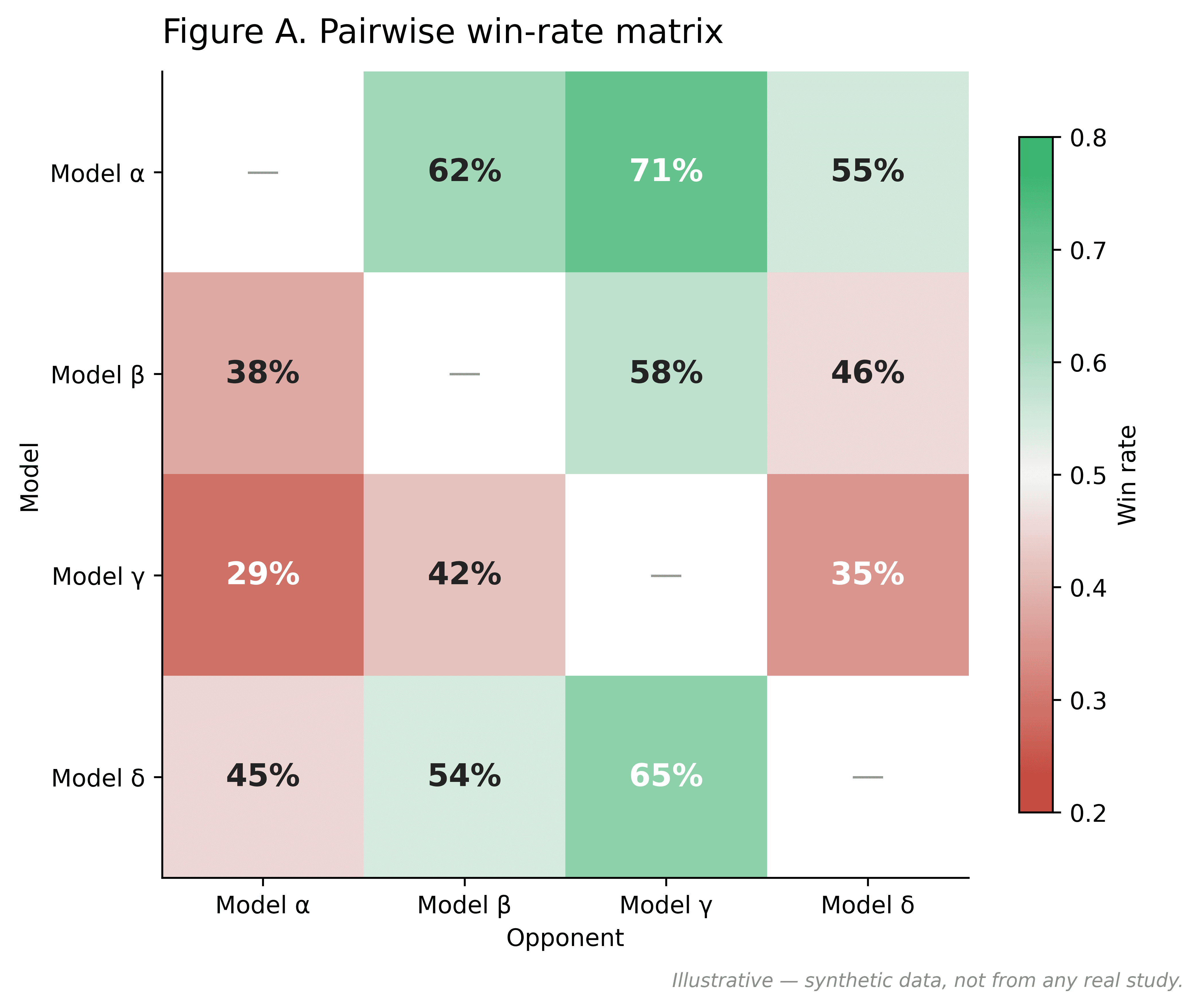
For every ordered pair of models (A, B), the proportion of evaluator-prompt observations on which A was ranked above B is computed and rendered as a model-by-model heatmap. The pairwise matrix is the rawest possible expression of the preference data, prior to any modeling assumptions. It exposes non-transitive patterns (where A beats B, B beats C, and C beats A) that would be hidden in a single-number summary, and provides the ground truth against which the Bradley-Terry estimates in §5.3 are checked.
5.2 Overall pairwise win rate
For each model, the average win rate across all opponents is computed and reported as a bar chart. This is a single-number summary suitable for headline reporting. It is paired with, not used in place of, the full pairwise matrix.
5.3 Bradley-Terry strength and Elo ratings
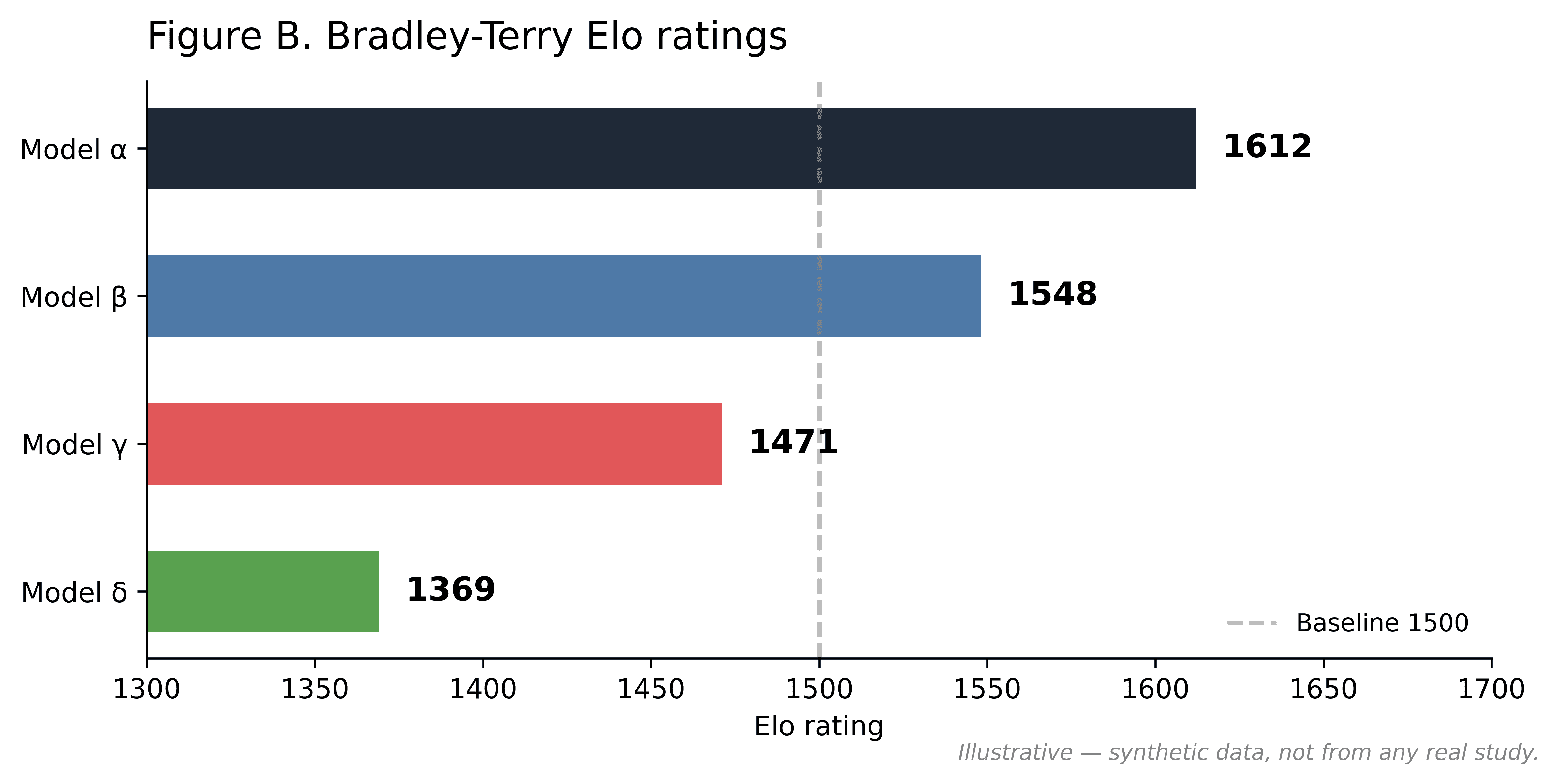
The Bradley-Terry model is a standard probabilistic model of paired-comparison data. It assumes that each model has a latent strength parameter s_i, and that the probability of model A being preferred over model B is the logistic function of (s_A − s_B). Two estimation methods are used in parallel.
The first is direct maximum-likelihood estimation of the Bradley-Terry parameters, recovering a calibrated strength score per model. The second is an iterative Elo update with fixed hyperparameters (k = 32, 50 passes over the pairwise data, fixed random seed for reproducibility). Elo ratings are the more familiar reporting format in the broader machine-learning evaluation community (for example, Chatbot Arena and LMSys), which makes Contra Labs results legible to external readers.
Bradley-Terry has two advantages over the raw win-rate summary in §5.2. It accounts for strength of schedule, so a model that beats stronger opponents is rewarded more than one that beats weaker opponents. And it yields a single calibrated scale on which gaps between models translate directly to expected win probabilities.
5.4 Rank distribution
For every model, the proportion of evaluator-prompt observations placing it in each rank position is reported as a stacked bar chart. Rank distribution surfaces consensus on a model's tier (a model that lands 1st or 2nd 80% of the time is qualitatively different from one that averages 2nd but is rarely placed 1st). For multi-phase studies, rank distributions are also rendered as ridge plots that show how the entire distribution shifts from phase to phase.
5.5 Per-segment win rates
Pairwise win rates are recomputed within each defined segment of the data (prompt type, design brief, deliverable category, creative phase) and reported side-by-side as faceted bar charts. Segmented analysis catches model behavior that aggregates away. A model that wins overall may lose decisively in a particular segment, and vice versa.
5.6 Scalar rating analysis
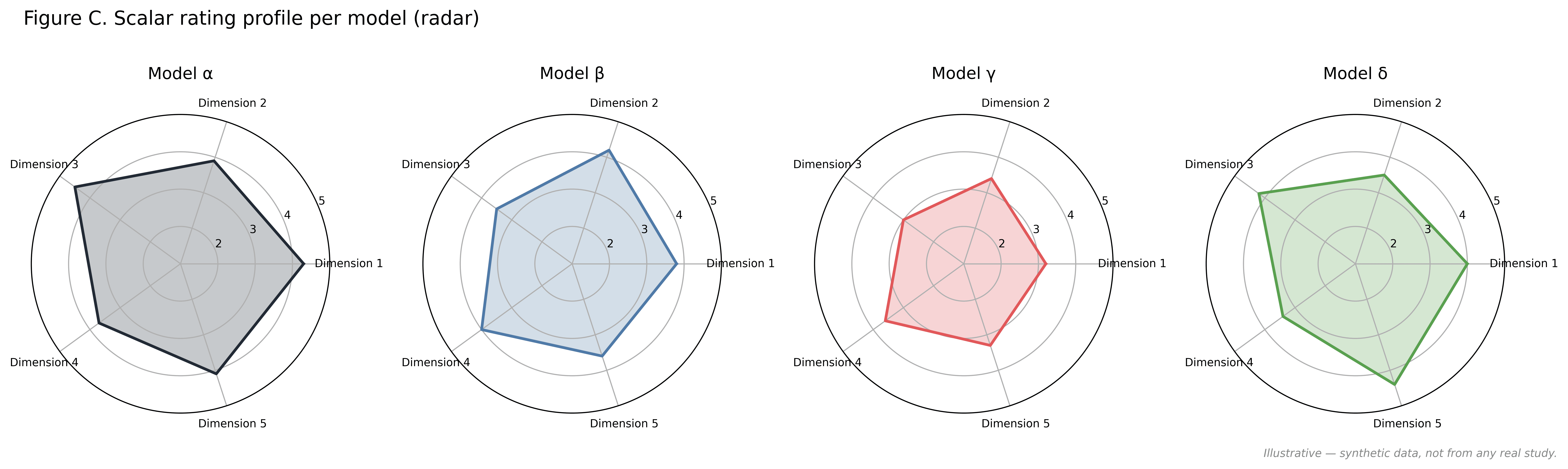
For each scalar dimension, the mean rating per model is reported, along with the full rating distribution per model and the distribution per evaluator. Three complementary visualizations are produced.
- Grouped bar charts of mean rating by model and dimension.
- Stacked bars or box plots of the rating distribution within each (model, dimension) cell.
- Radar plots that place all dimensions on a single chart per model, making strength profiles directly comparable across models at a glance.
A correlation matrix of the scalar dimensions is also reported. Strong off-diagonal correlations indicate that two nominally independent rubric dimensions are functioning as the same construct in the evaluator's mind, which is useful diagnostic information when revising the rubric for the next study.
5.7 Structured qualitative coding
Free-text rationale responses are passed to a large language model under a fixed extraction prompt that returns labelled themes of two kinds: strengths (positive statements about a model's output) and weaknesses (negative statements). Extraction outputs are cached so that repeated analyses are deterministic.
Three analytic views are produced from the coded themes.
- Theme frequency: how often each theme appears across the corpus, irrespective of model.
- Theme sentiment: the count of strength, neutral, and weakness mentions per theme, reported as a diverging bar chart.
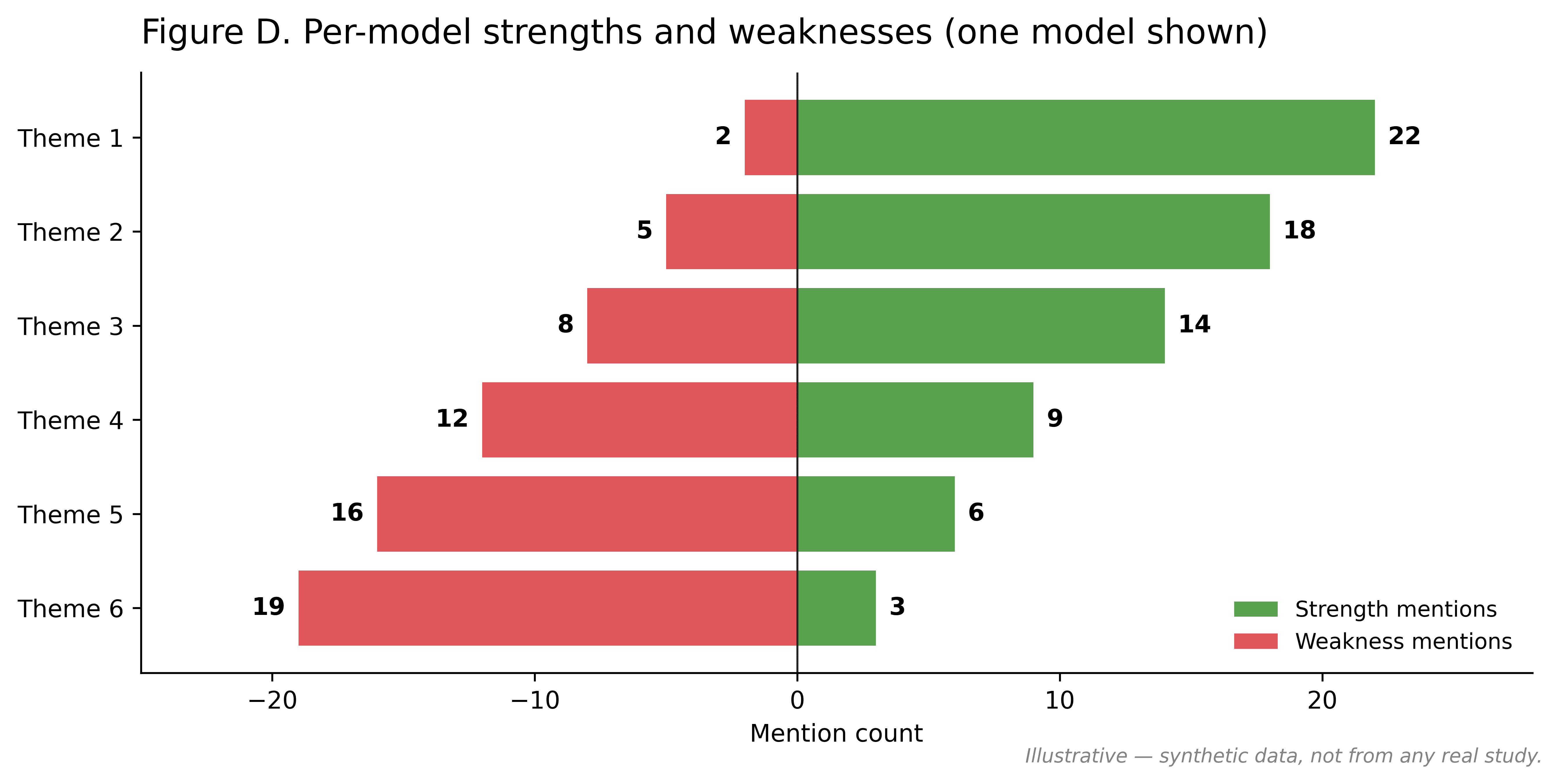
- Per-model strengths and weaknesses: for each model, the top themes and their strength-to-weakness ratio, reported as a horizontal bar chart with strengths to the right and weaknesses to the left.
Structured coding is used because raw sentiment analysis loses domain specificity (the difference between good lighting and good composition is invisible to a polarity classifier), while reading hundreds of rationale responses by hand is intractable and not reproducible. Theme extraction produces a transcript-grounded qualitative summary that can be cited alongside the quantitative findings and audited if questioned.
5.8 Theme co-occurrence (epistemic network analysis)
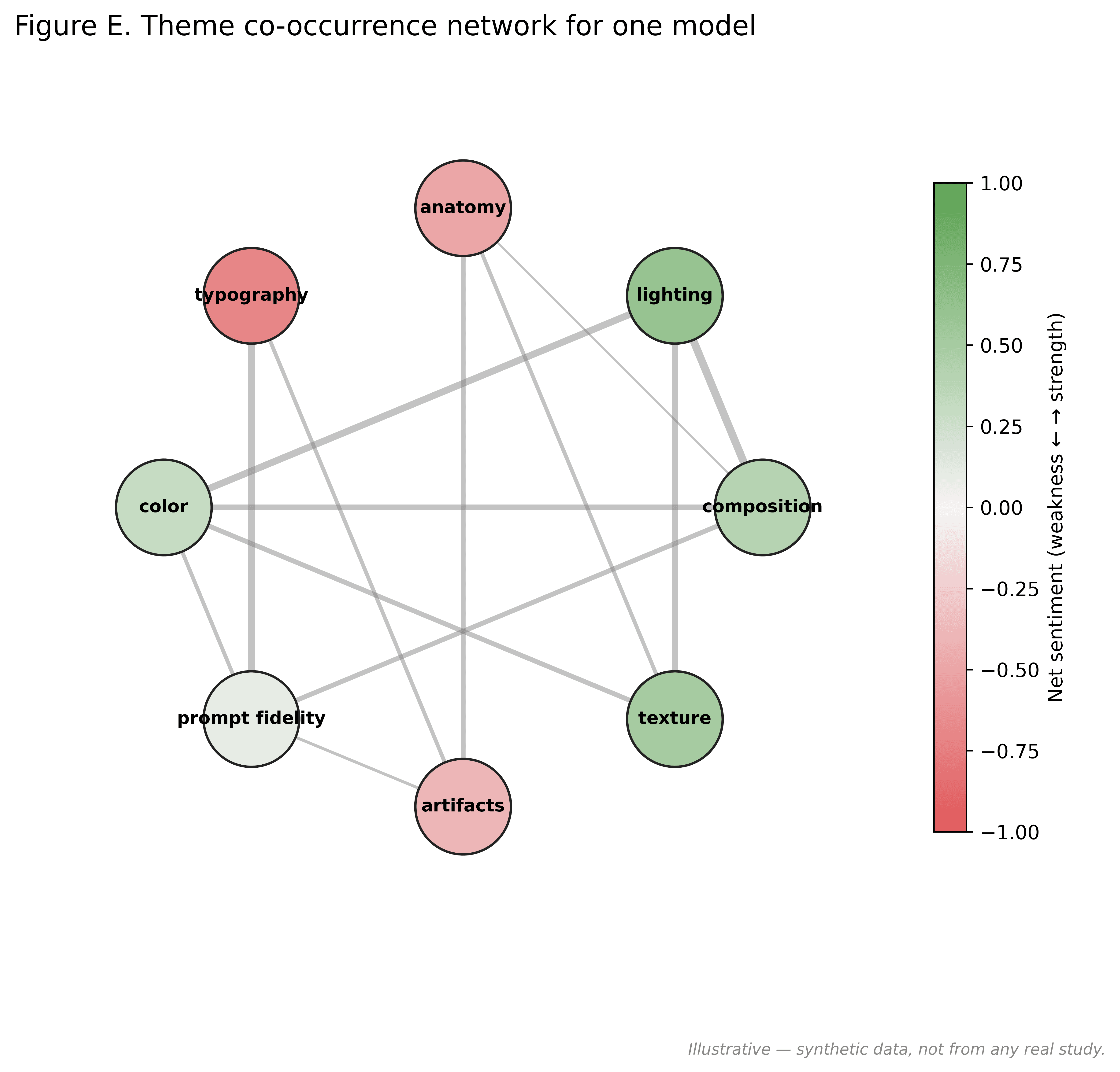
The qualitative themes from §5.7 are also analyzed as a network. For each model, a co-occurrence graph is constructed where nodes are themes and edges are weighted by the number of evaluator responses that mention both endpoints together. The resulting per-model network is rendered as a force-directed graph in which node color encodes the strength-to-weakness sentiment for that theme and edge thickness encodes the strength of co-occurrence.
Theme co-occurrence networks reveal which weaknesses and strengths cluster together. They turn an unordered theme list into a structured picture of how the panel collectively talks about a model. For pairwise model comparisons, a difference network is computed that highlights themes mentioned predominantly for one model versus the other.
5.9 Net sentiment heatmaps
A model-by-theme matrix is computed in which each cell holds the net sentiment for that (model, theme) pair, defined as strength mentions minus weakness mentions, divided by total mentions. This is rendered as a diverging heatmap and provides a single compact view of comparative strengths and weaknesses across the entire model set. For multi-phase studies the heatmap is repeated per phase and as an aggregate.
5.10 Cross-phase comparison (multi-phase studies only)
When the study covers more than one production phase, every analysis above is computed within each phase and then compared across phases. Specific cross-phase outputs include:
- Win rate, Bradley-Terry strength, and Elo rating per model per phase, plotted as grouped bars or as a line chart that emphasizes trajectory.
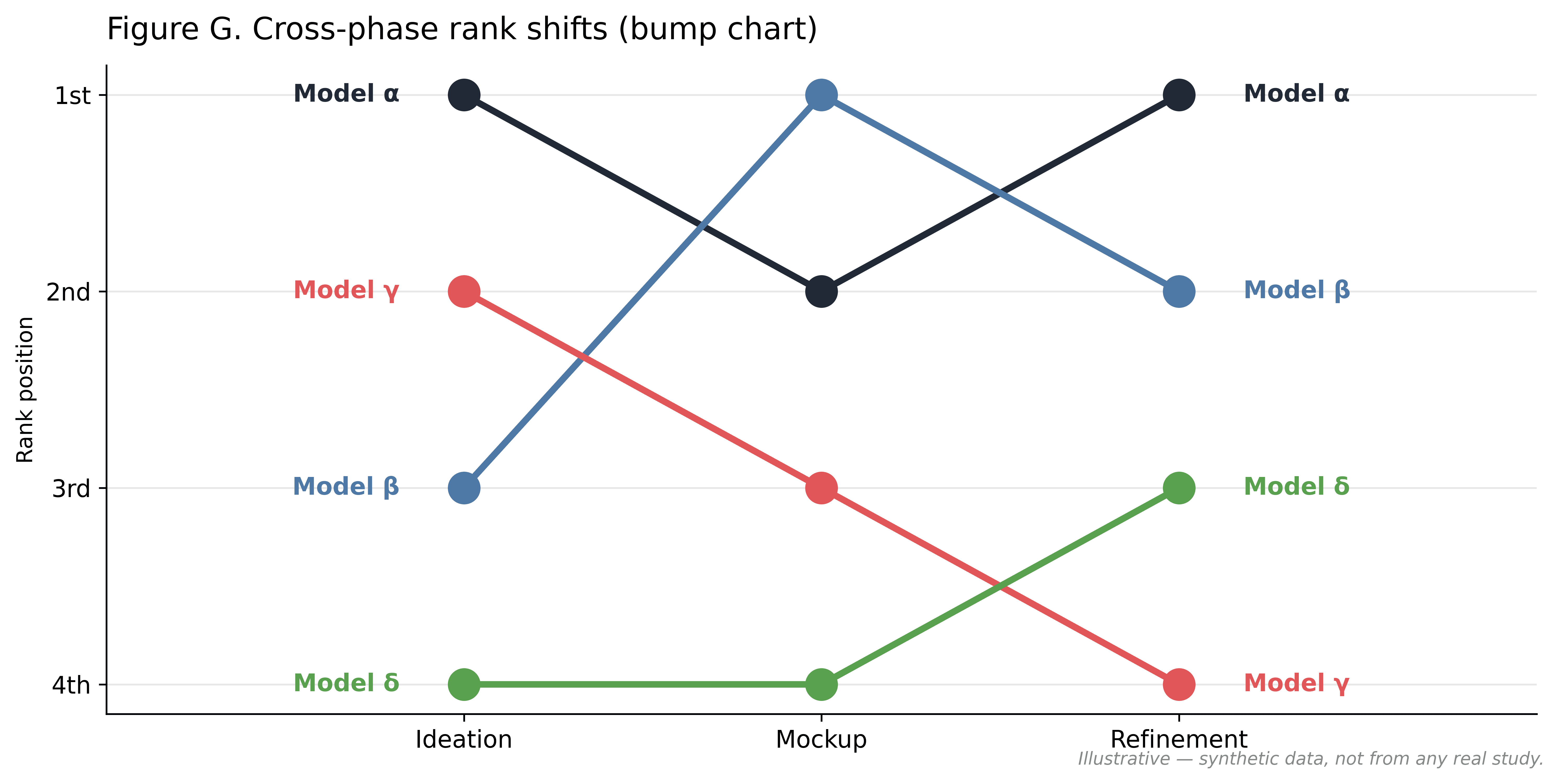
- Bump charts that show how each model's rank order changes between phases.
- Mean rating per scalar dimension per phase, plotted as grouped bars.
- Theme evolution charts that show which qualitative themes grow or fade across phases.
- A comprehensive summary table that records, for each model and phase, all headline metrics in one place.
Non-parametric statistical tests are applied to the cross-phase data to decide whether observed shifts are statistically meaningful. The Friedman test is used to compare ranks across phases within rater, with Wilcoxon signed-rank as the post-hoc pairwise test. Kruskal-Wallis is used to compare scalar distributions across independent groups. Reporting both effect size (the magnitude of the shift) and significance (the test p-value) ensures that small but reliable changes are not mistaken for noise, and that large but uncertain changes are flagged as such.
5.11 Output spotlights
Each report concludes with a small number of curated prompt-level case studies in which the reference input, prompt text, and every model's output are shown side-by-side, annotated with the actual rank and scalar ratings assigned by the panel. These spotlights ground the aggregate statistics in inspectable examples, which materially improves stakeholder trust in the reported findings.
6. Inter-rater reliability
A central question in any panel-based evaluation is whether the panel's conclusions would replicate under a different panel of evaluators with the same expertise. This is addressed with a battery of diagnostics, computed in every study, that together describe the panel's internal agreement at several different grains.
6.1 Krippendorff's α on scalar ratings
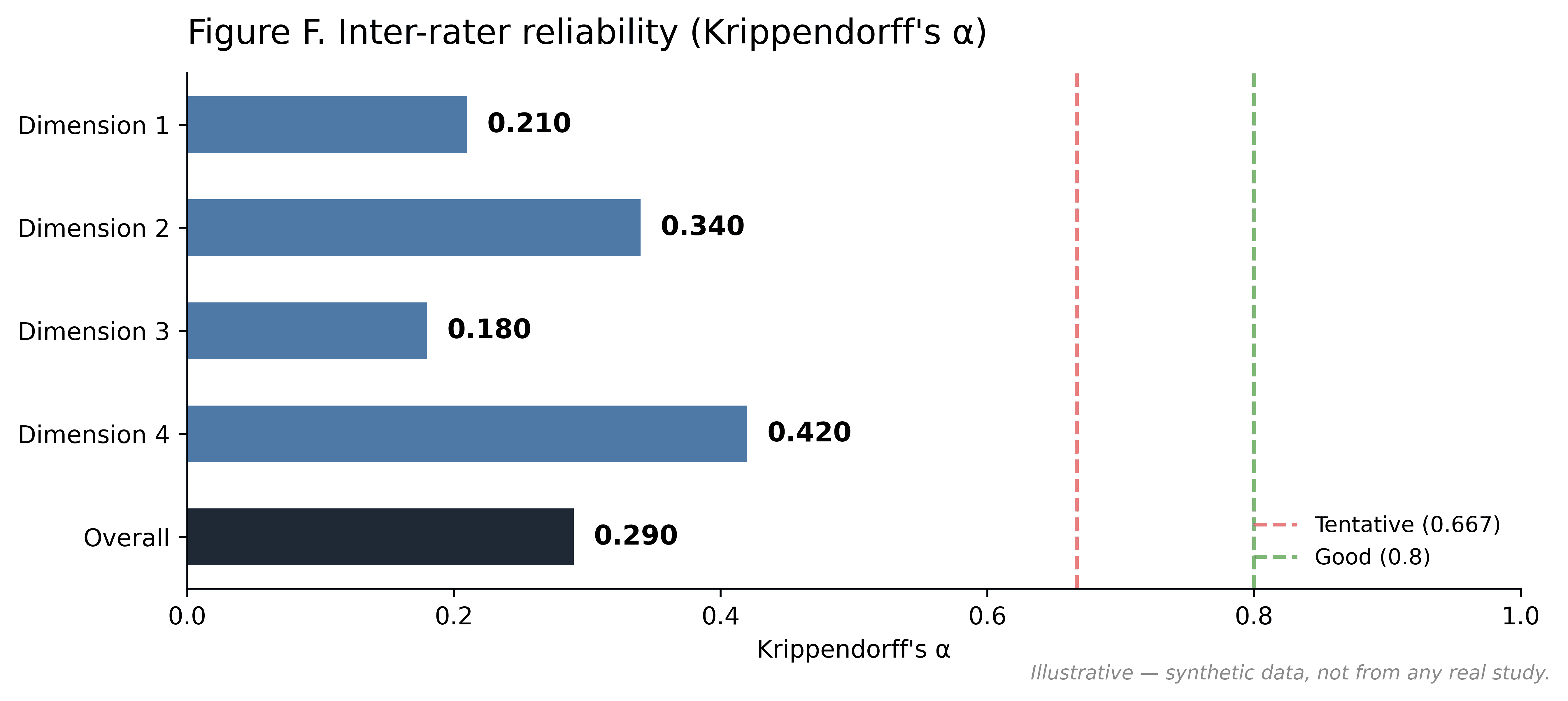
Krippendorff's α is a general-purpose coefficient of agreement that handles arbitrary numbers of raters, missing data, and multiple measurement levels (nominal, ordinal, interval). It returns a value in (−∞, 1], where 1.0 indicates perfect agreement, 0 indicates agreement at chance, and negative values indicate systematic disagreement.
Conventional thresholds for substantive use are α ≥ 0.8 (acceptable), 0.667 ≤ α < 0.8 (tentative, suitable for exploratory analysis only), and α < 0.667 (unreliable). α is computed on the scalar rating data with the interval distance function. α is consistently the lowest reliability number reported in any study, which is the expected pattern for absolute Likert ratings across heterogeneous human raters. Scalar means are reported with this caveat and treated as directional rather than absolute.
6.2 Krippendorff's α on rankings (ordinal)
α is recomputed on the rank data using the ordinal distance function, which penalizes large rank differences more heavily than small ones. Comparing the ordinal-rank α to the interval-scalar α quantifies how much agreement information is gained by switching from absolute rating to relative ranking. In practice rank α is meaningfully higher than scalar α, which is one of the reasons pairwise analyses receive primary weight in the report.
6.3 Kendall's coefficient of concordance (W) per prompt
Krippendorff's α returns a single number for the entire study. Kendall's W returns a single number per prompt: the proportion of variance in the panel's aggregate ranking that is explained by genuine consensus rather than noise. W ranges from 0 (no concordance) to 1 (perfect concordance), with W ≥ 0.5 conventionally interpreted as strong, 0.3 to 0.5 as moderate, and below 0.3 as weak. Per-prompt W identifies which prompts produced a clear consensus winner and which split the panel. The latter are flagged for closer inspection, since low concordance can indicate either that the models are genuinely interchangeable on the prompt or that the prompt itself is ambiguous.
6.4 Pairwise Spearman rank correlation between evaluators
For every pair of evaluators, the Spearman rank correlation of their assigned ranks on the prompts they both evaluated is computed. The full N-by-N correlation matrix is reported as a heatmap, and each evaluator is assigned a panel-fit score equal to the mean of their correlations with the rest of the panel. This diagnostic is primarily operational. It identifies a consensus cluster of evaluators whose judgments converge with the majority of the panel, and it flags outliers whose rankings diverge. Panel-fit scores feed directly into rehire decisions for future studies.
6.5 Hierarchical rater clustering
The pairwise Spearman correlations between evaluators are inverted into a distance matrix and passed through hierarchical agglomerative clustering. The resulting dendrogram is reported alongside the correlation heatmap and reveals whether the panel splits into stable subgroups (for example, a majority cluster of evaluators in broad agreement and a minority cluster with a different aesthetic prior) or whether it behaves as a single population. Where multiple clusters exist, downstream analyses can be repeated within each cluster as a sensitivity check, and rubric calibration sessions for future studies can be designed to address the dimensions on which the clusters diverge.
6.6 Reporting
All five diagnostics are reported in every study rather than collapsed into a single number. A study with strong rank concordance and weak scalar agreement, for example, supports claims about ordering but not about absolute magnitude. A study with two clearly separated rater clusters supports claims within each cluster but warrants caution in aggregate. The reader is given the data needed to weight every quantitative finding accordingly.
7. Recruiting
7.1 Panel size
A Contra Labs panel is typically composed of eight to twelve evaluators per study, with smaller pilot studies running as low as five and larger studies extending to fifteen. Panel size is chosen to balance two competing requirements: enough evaluators to produce stable aggregate rankings and to compute inter-rater reliability with meaningful confidence intervals (see §6), and few enough to allow thorough screening, onboarding, and per-study compensation at a sustainable cost.
7.2 Candidate profile
Evaluators are recruited from the Contra freelance network and, where domain expertise is specialized, from targeted outreach to partner companies and professional communities. Every panelist for a study must satisfy a set of role-relevant criteria written specifically for the study's creative domain. The general pattern is as follows.
- Active practitioner. The evaluator currently works in the target domain as part of their day-to-day professional practice, not as a hobby or as a former practitioner.
- Mid-level or senior experience. Approximately four or more years of professional experience in the target domain, sufficient to have internalized the judgment criteria the rubric is testing.
- Direct exposure to the deliverable type. The evaluator has shipped work of the kind being evaluated (for example, a study of brand-campaign image generation requires evaluators who have produced brand or campaign visuals in their own work).
- Demonstrated judgment on each rubric dimension. The evaluator can articulate what makes an output good or bad on every dimension of the study's rubric, validated during screening with a short calibration task.
- Comfortable with the workflow. The evaluator is willing and able to review many side-by-side comparisons in sequence and to produce concise, useful written feedback.
The exact criteria are documented in a per-study participant brief that the recruiting team uses for outreach and screening.
7.3 Screening and onboarding
Candidates submit a brief portfolio or work-sample review during application. Recruiters check each candidate against the participant brief and run a short calibration exercise that mirrors the live study: a small number of representative prompts, the same instrument the live study will use, and a debrief in which the candidate explains their rationale. Calibration outputs are reviewed for rubric understanding rather than for "correct" answers; candidates who can articulate why they judged each output the way they did are admitted to the panel.
Before live data collection begins, the admitted panel receives written guidelines that restate the rubric, define each scalar dimension, and walk through the evaluation interface. Time is left for clarifying questions in advance of the study window.
7.4 Compensation
Evaluators are paid a fixed honorarium per study. Honoraria are calibrated to the expected time commitment and to prevailing market rates for the evaluator's professional background, and typically fall in the low hundreds of US dollars for a one-week study window. Compensation is stated up-front in the participant brief and is not contingent on the direction of the evaluator's judgments.
7.5 Rehire criteria
Evaluator performance from completed studies is logged and used to inform invitations for subsequent studies. The principal performance signals are completion (did the evaluator finish their assigned tournaments inside the window), rationale quality (were the written responses specific, actionable, and grounded in the outputs), and panel fit (how strongly did the evaluator's rankings correlate with the rest of the panel; see §6.4). Low panel fit is not in itself disqualifying. An outlier may be a domain specialist whose taste differs from the majority in a study-relevant way, but it is reviewed alongside the other signals when assembling future panels.