

Contra Labs ran Gemini (Nano Banana Pro) through a production-style campaign workflow. 29 deliverables. 55% reached Client V1. Only 24% reached Production Ready. The gap between those two numbers is one prompt pattern.
Across the three core deliverables, Gemini reached Client V1+ on 16 of 29 scored deliverables (~55%), but only Production Ready on 7 of 29 (~24%). The strongest sessions show why. Two of ten participants reached Production Ready on Hero, Social, and Secondary assets where their prompts translated a campaign brief into specific image assignments: format, role, subject, product, lighting, material, mood, and continuity.
The remaining sessions still produced usable work. Most reached Client V1 Ready or Ideation acceptable. What follows compares Production Ready outputs against sessions that fell short of that line.
The lower-readiness sessions looked different. Their prompts often asked Gemini to carry too many kinds of production precision at once: readable type, logos, product accuracy, model consistency, sharper resolution, layout fixes, or brand-polish details. Those are real production needs, but they were less reliable as prompt-only tasks.
The distinction that matters is image-native direction versus stacked production execution. Gemini was strongest when the prompt's detail described the campaign image itself. It was weaker when the same prompt also asked Gemini to behave like a layout designer, typographer, logo renderer, and retoucher.
Hero prompts worked when they gave Gemini a campaign job
A strong Hero prompt tells Gemini what the image is for.
One Production Ready Hero prompt did that clearly. It asked for a homepage hero image, not just a furniture scene. The prompt specified negative space for marketing copy, wide-angle composition, golden-hour lighting, the recurring brand model, and the key SKU placement.
For the next phase, please generate a candid, wide-angle interior photograph of a minimalist 'Soft Brutalism' apartment at golden hour, serving as a homepage hero image. The expansive space features a polished concrete floor and textured plaster walls in Sandstone and Sage tones. Dramatic, warm directional sunlight beams stream through a large window on the left, casting long, soft-edged geometric architectural shadows across the room. Aris, a calm and meditative mid-30s androgynous creative professional with natural textured hair and wearing an oversized beige linen jumpsuit, is seated comfortably in the off-center 'Metric Lounge Chair' on the right, looking out the window while holding a ceramic tea bowl. The 'Metric Lounge Chair' has a solid white oak geometric frame and is upholstered in a rich Electric Cobalt blue wool, which provides a striking contrast against the earthy palette. In the mid-ground behind Aris, the tall 'Calyx Floor Lamp' stands with its blackened steel stem and wide, hand-pressed paper shade. Further into the background, a glimpse of the pill-shaped 'Mesa Coffee Table' in honed travertine is visible. The composition leaves substantial negative space on the left side, designed for marketing copy. High-fidelity textures define the scene, from the grain of the white oak and the weave of the cobalt wool to the porosity of the travertine and concrete. The overall mood is serene, grounded, and premium yet relatable.Full prompt example: Production Ready Hero direction

This prompt gave Gemini a bounded creative problem. The prompt defined the role of the asset and the visual rules around it.
The lower-readiness Hero chain was detailed and directional. The issue was that it asked Gemini to solve two jobs at the same time: create a cinematic campaign image and execute a graphic layout with logos, tagline, secondary copy, legal text, credits, and motion-like perspective. That is a lot for an image model to resolve at once, especially when the output also needs to feel client-ready.
The Urban Nomad is a high fidelity/premium anti-theft backpack for tech professionals. It has multi-compartiments a fold clip open for an easy access to the elements that are inside. A zipper that has a clear visual locking state for users objects security. It should feel like a secured anti-theft backpack — but still with a modern and designed look. It has a modern pale tint with always a vibrant complementary color for small details on the backpack (e.g. tabs, zipper). The branding is simple and modern, with two different logo presentation. One which is only the monogram (modern shape composition) and one which is a logotype with a sans serif thick font that has a tech vibe. We're going to create a photoshoot campaign with one model that is staying across the multiple versions. The model has a photoshoot pose, holding the backpack by his fingers behind his back and is doing a fake walk for photoshoot. The background should feel like a photo studio with colored blocks the whole scene should be in one color (should be one of the colors used on the backpack's design). Let's start with the first campaign shoot that is going to be 1920x1080, the feel should be something with dynamic lens rotation blur but keeping the main element clearly visible. The two logos (typographic and monogram) and some text elements are placed on top left of the frame. Text elements are a tagline; 'work without fear' and a secondary text element; 'Designed in Sweden'. On bottom right corner, we should have legal text and credits.Full prompt chain: lower-readiness Hero contrast
Three follow-up prompts asked for an iteration with exaggerated perspective on a staircase, environment distortion, and added text overlay.

The difference is practical. The Production Ready Hero prompt kept the world-building and the asset role as the main task. The lower-readiness Hero chain also built a world, but it carried that world into finished graphic design, readable brand copy, logo execution, and an exaggerated-perspective setup.
Social prompts worked when continuity was explicit
Giving Gemini a clear job extends across formats. A campaign has to move from Hero to Social to supporting assets without losing the world, and the stronger prompts treated continuity as part of the creative direction rather than something to correct after the fact. The better prompts repeated the anchors that mattered: same model, same SKU, same outfit, same material palette, same lighting, same mood, new format.
One Production Ready Social prompt is a clean example. It asked for a fresh 9:16 generation, not a crop, while preserving the brand model, the SKU system, and the campaign world.
Great! Thank you. Moving on to deliverable 2, please generate an image based on the below brand context. Please use the exact same SKU and brand model as created. Social Cut: 'The Quiet Morning.' Specs: 9:16 (Vertical). Subject Focus: A medium-close-up of Aris interacting with the Calyx Floor Lamp. Framing: This is a fresh generation, not a crop. Aris should be adjusting the paper shade or sitting beneath its glow. Focus on the contrast between the warm lamp light and the cool Cobalt accent of the chair visible in the periphery. Storytelling: Aim for a 'TikTok Cover' aesthetic — aspirational, 'lifestyle-first,' with enough negative space at the top/bottom for UI overlays (username, caption, etc.).Full prompt example: Production Ready Social continuity

The important move is "make a different asset inside the same campaign system." Gemini can extend a world across formats, but the prompt has to say which parts of the world are load-bearing.
The lower-readiness Social chains were more likely to turn into corrective prompting. One Social chain, for example, asked Gemini to keep the same person while changing the scene, keeping the product visible, preserving brand tones, sharpening the result, making the logo text clear, changing the shirt color, and improving the model's skin. The prompt had continuity anchors, but the task kept shifting into precision fixes.
Make a 9:16 image. Keep the same woman, she's in a different scene now. She is in her bathroom, same hairstyle, same shirt, same tones, so the off white color. She is holding a tube of sunscreen. The sunscreen tube is white with a light blue lid on it. She's holding the tube up to her face. The tube is minimal white with just the SOLENE text logo. Same as previous image. She has a slight smile, glowing skin.Full prompt chain: lower-readiness Social contrast
Change her shirt color to light blue.
Make her skin clear and glowing.
Can you upscale this image so it is clear. Make sure text is clear as well.
That is the difference between campaign continuity and accumulated repair. The strongest Social prompts treated the vertical asset as a deliberate campaign execution, either a fresh scene or a considered reframe. The weaker chains asked Gemini to preserve, correct, sharpen, brand, and beautify the same output until the prompt was doing the work of a retoucher.
Secondary prompts worked when detail became the story
Some of the strongest campaign support work came from prompts about material proof: travertine, wool, stitching, stone pockmarks, skin texture, golden-hour light, fabric grain. These details did not just decorate the image. They made the brand world feel tangible.
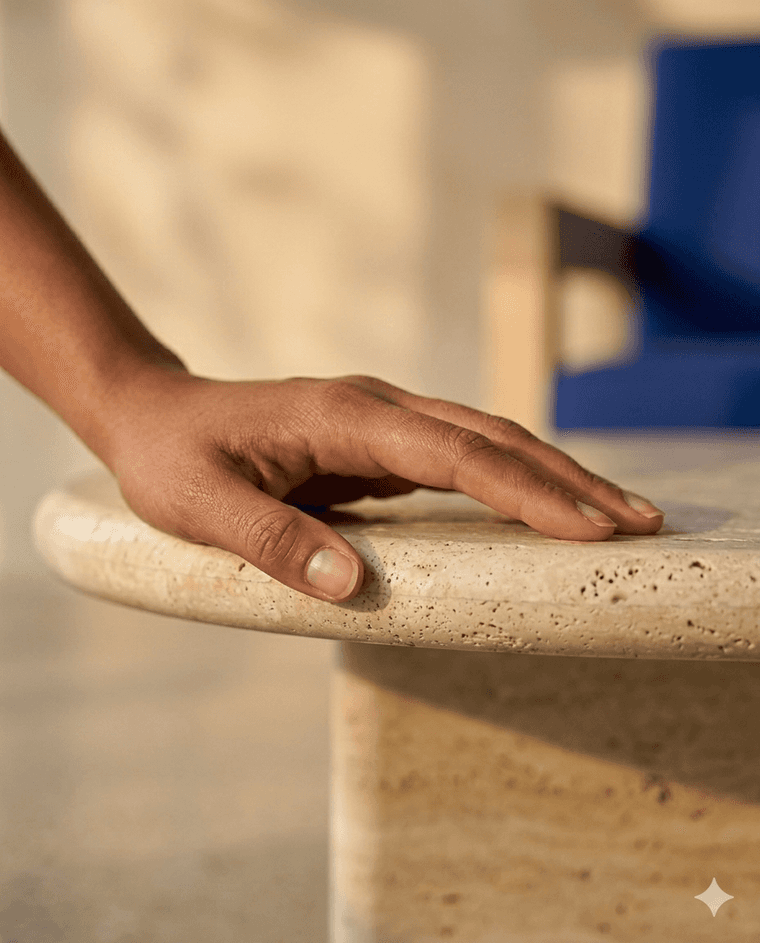
One Production Ready Secondary asset chain is the clearest example. The prompt narrowed around the model's hand, the table, the cobalt wool chair, the white oak frame, stitching, the stone edge, and 4:5 placement.
This is amazing for a first image version for the social cut! Moving on to deliverable 3, please generate an image based on the brand context below. Please use the exact same SKU and brand model as created. Secondary Asset: The 'Materiality' Macro. Specs: 1080x1350 (4:5 Portrait). Placement: Product Detail Page (PDP) or Instagram Carousel 'Slide 2.' Subject Focus: A macro 'tactile' shot. No face — just Aris's hand resting on the honed travertine edge of the Mesa Coffee Table. Why this format? The 4:5 ratio is the 'gold standard' for Instagram feed engagement. By focusing on the texture of the stone and the skin tones of the talent, you reinforce the 'Grounded/Premium' brand pillar. It proves the quality bar of the furniture while keeping the human element (Aris) present.Full prompt example: Production Ready Materiality Macro
One Client V1 participant came close with a similar approach. Their secondary prompts pushed into fabric weight, clothing texture, fit, and accurate product detail. That helped all three deliverables reach Client V1 Ready, but not Production Ready. The prompt work was specific and useful, yet it stayed closer to product-accuracy evaluation than a fully finished campaign image.
Now create a 1080x1080 aspect ratio image featuring a close up of the fabric where the sport bra band meets the models skin. The fabric should appear thick and high quality. This image will be used to show off the texture and colour of the garment, so should be high resolution and detailed, with some light creasing. Ensure that the fabric colour and texture is accurate to the original photos, and that the skin tone matches the model's.Full prompt chain: Client V1 Secondary
Ensure the sports bra is accurate to the original ghost image.

Detail helps most when it is the purpose of the asset. The Production Ready macro worked because materiality was the assignment. In lower-readiness chains, detail often appeared as a correction after the image had already missed some product or brand requirement.
What separated Production Ready prompts from the rest
The Production Ready prompts had a consistent shape. They started with the deliverable, then described the campaign system around it. The prompt usually answered five questions before asking Gemini to render anything: What is this asset for? What should stay consistent? What is the subject or product? What materials and lighting define the world? What should be excluded?
The lower-readiness prompts often had those ingredients too. Some were detailed and directionally strong. The issue was job stacking: asking Gemini to generate the campaign image while also handling readable typography, exact product markings, color changes, sharper resolution, skin polish, logo placement, and legal copy. The study suggests it cannot reliably do all of that at once and still reach the same readiness bar.
The issue tags reflect that pattern. Across all outputs below Production Ready, the most frequently tagged issues were edit control (8 tags), realism/physics (8 tags), prompt adherence (7 tags), composition (6 tags), and anatomy (6 tags). Edit control and prompt adherence point to execution the prompt asked Gemini to carry. The rest point to generation limits that get worse when the prompt is already overloaded.
That is why the fully Production Ready sessions are the strongest examples. Their prompts made Gemini solve creative direction first. They used constraints to define the campaign world. The lower-readiness chains more often became a sequence of corrections after the first output missed a production detail.
The difference was visible across the three deliverables. Hero prompts got stronger when they named the campaign role. Social prompts got stronger when they treated the vertical asset as a new execution inside the same world. Secondary prompts got stronger when material detail was the point of the asset, not a late attempt to rescue accuracy.
Verdict
Gemini (Nano Banana Pro) is strongest when the prompt acts like a creative brief for a specific asset. The closer the user gets to naming the asset's job, anchoring the campaign world, and specifying the material and visual language, the closer Gemini gets to a usable campaign image.
The strongest prompts were specific in the right places: format, role, subject, product, light, material, mood, continuity, and exclusions. Length on its own didn't predict readiness.
The practical takeaway: use Gemini to turn a brief into a campaign image before asking it to finish the production system around that image. Start with the asset's job, repeat the campaign anchors, specify the material world, and make each deliverable a deliberate execution. Keep final typography, logos, legal copy, and exact layout polish out of the generation whenever possible.
Methodology
Contra Labs ran a production-style Gemini (Nano Banana Pro) workflow study with working creatives. Each participant brought a campaign brief and produced three deliverables: a Hero still (1920×1080), a Social cut (9:16), and one Secondary supporting asset.
After each deliverable, participants rated the output's readiness state: Needs more iteration, Ideation acceptable, Client V1 Ready, or Production Ready. They also selected issue tags and narrated what worked, what failed, and where they would continue in Gemini versus hand off to another tool.
The comparison focused on the Hero, Social, and Secondary prompts whose outputs got closest to client readiness, especially the sessions where all three deliverables were marked Production Ready. Those sessions were compared with lower-readiness deliverable prompts to understand which prompt patterns helped Gemini produce credible campaign assets.
Limitations
The study is directional, not a calibrated benchmark. Readiness states and issue tags were selected by the participants evaluating their own work. The four readiness states were not defined for participants; each participant applied their own professional judgment about what constituted Client V1 Ready versus Production Ready. The results carry the usual self-assessment and on-camera bias. An outside reviewer may have rated the same outputs differently.
The prompts were not controlled experimentally. Participants wrote in their own styles, used different client briefs, and had different levels of experience translating creative direction into image prompts. That variation is useful for studying real workflows, but it means we cannot isolate a single prompt feature as the cause of a better output.
These findings should be read as workflow evidence, not universal prompting rules. They show patterns that appeared in the strongest sessions: asset-specific direction, repeated campaign anchors, material detail, and format-aware prompting. They do not prove that the same phrasing will produce the same result across every category, model version, or creative brief.
How we ran this study → Methodology