

4 frontier models built 40 landing pages. 8 designers went through them one page at a time and drew 754 boxes around the parts that failed.
Every model broke differently. Sol got marked for size and placement, Fable for finish, Grok for how a page behaves when you touch it, Muse Spark for the volume of the marks.
This follows last week's study, where 4 models ran against 10 briefs and 9 designers judged them blind. That round found the brief picks the winner: GPT 5.6 Sol won 82% of its loose-brief matchups, Claude Fable 5 led on tight specs, and Sol finished last. This round asks a narrower question: page by page, where does each model break?
The mechanic was simple. Each designer drew a box around anything they read as a failure, tagged it with one of 8 labels (layout/spacing/hierarchy, polish and consistency, typography, originality, color and contrast, interaction and motion, cues and affordances, brand fit and tone), and rated it minor, major, or a blocker. 5 briefs, 4 models, 40 pages, 754 marked failure points.

2 tags lead for everyone. Layout, spacing and hierarchy is the most marked tag in the study, polish and consistency is second, and that order holds for 3 out of the 4 models. The models separate on what comes after.
More than half of Sol's issues are about size and placement.

Sol drew fewer failure points than any other model in the study. 136 in total, against Muse Spark's 210. Per designer per page that is 3.4 annotations to Muse Spark's 5.25. The annotations were gentler too. Two thirds were minor, and Sol accounts for 4 of the 47 blockers in the study.
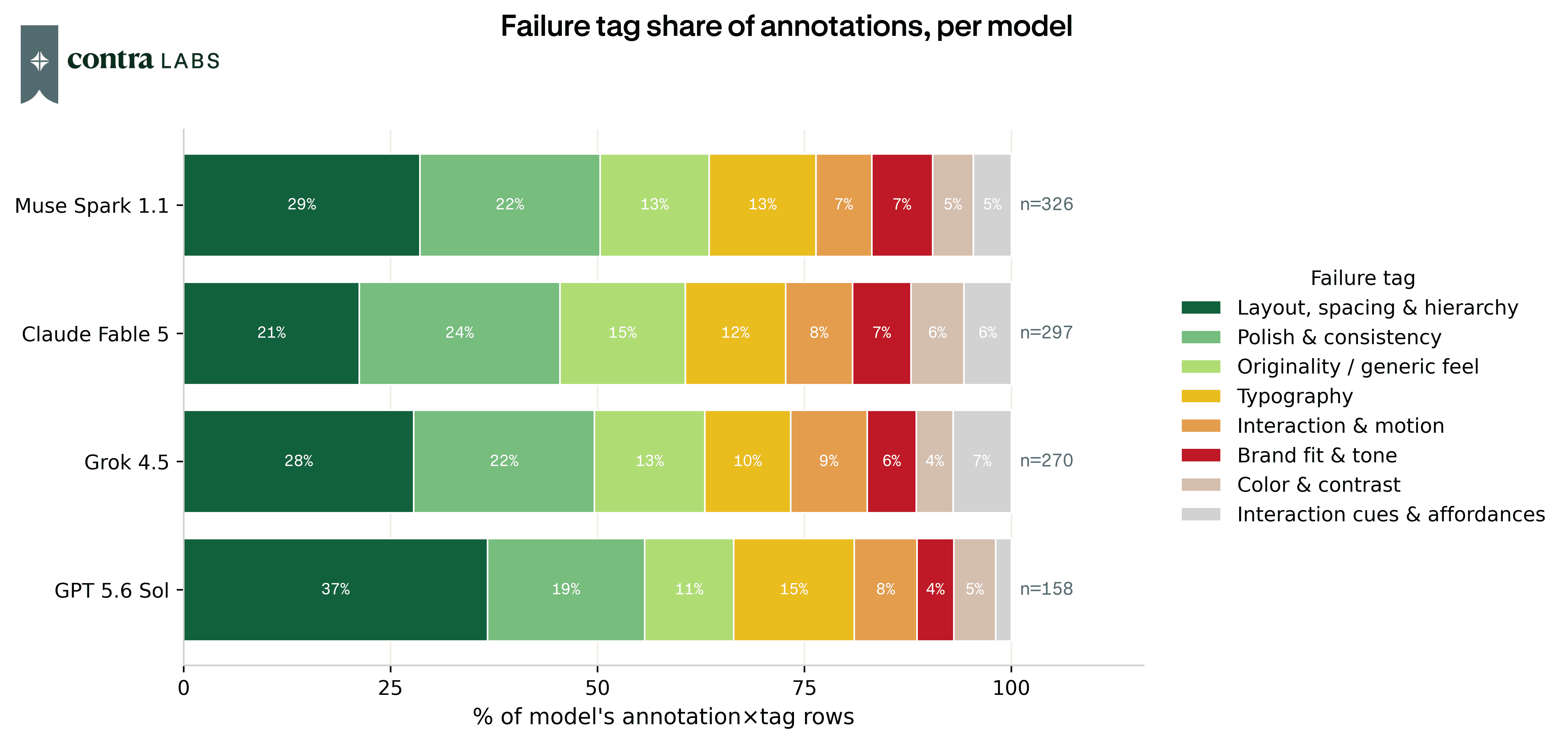
Sol's highest share came from one place. Layout, spacing and hierarchy accounts for 37% of its tags, the biggest concentration any model reached, and typography adds another 15%. More than half of everything designers flagged on a Sol page came down to how big something was or where it sat. Sol's feedback produced 4 blockers in the whole study. 3 were layout, from 3 different designers on 3 different pages.

Switchboard is where it peaks. 56% of Sol's tags on that page were layout, spacing and hierarchy, all 8 designers marked at least one, and it ties as Sol's heaviest page for major and blocker annotations. It's the brief where Sol did worst in the first study, winning 1 matchup out of 27. Shown the page alone, the designers went after the same thing again.
Fable's biggest tag is polish and consistency
Fable drew 191 annotation comments, 4.7 per designer per page, which puts it second on volume, close to Grok, and second on severity at 36% major and 5% blocker.

Polish and consistency accounts for 24% of its annotation tags and is Fable's biggest failure point. Fable is the only model in the study whose biggest problem isn't layout. Per page, Fable draws 1.75 polish annotations, more than any other model.
On Fable pages, a polish annotation typically identifies an inconsistency between different parts of the same page. The eight designers left 70 of them, across all five briefs. Here are some of the comments:
Not consistent, why everywhere is 1 line, and here there are 2.
Two separate body fonts are being utilized. I would downsize to one font.
Graphic line running through text making it illegible.
The line in the middle of the section looks like an error more than an intentional creative decision.
40% of all polish annotations were tagged major or blocker, which means a designer would have to fix them before sharing with a client.

The Undercurrent page is where this issue shows up most. A third of what designers marked on that page was polish and consistency, Fable's highest on any brief, and six of the eight designers left at least one polish annotation comment on the page.
For every other model layout is the most annotated failure tag by six to seventeen percentage points. Fable's share for layout issues is at 21%, the only model with under a quarter.
Grok's blocker rate is the highest in the study
Grok sits mid table on volume, 184 points at 4.6 per designer per page. It carries the highest blocker rate in the study at 9.2% of its rated annotations, with Muse Spark close behind at 7.6%. Those blockers are equally distributed among the top 3: polish, layout and originality.

Grok's profile is close to field average. Layout at 28%, polish at 22%, originality at 14%. The one place it moves is interaction. Interaction and motion plus cues and affordances make up 16% of Grok's annotations, the heaviest interaction load in the field. Typography at 10% and color and contrast at 4.4% are the lowest shares of any model.

Tidewater brief shows this perfectly. Interaction tags account for 27% of everything designers marked on that page, against 11% for Muse Spark, 9% for Fable and 5% for Sol on the same brief. Grok is the only model that got marked for what its page did rather than how it looked.
Muse Spark drew the most annotations in the study
210 rated annotations, 5.25 per designer per page, the most in the study. 48% of them were major or blocker, against Sol's 32%. That works out at 2.5 serious annotations per designer per page, more than double Sol's 1.1. And it holds brief by brief rather than resting on one bad page: Muse Spark drew the most serious annotations on 4 of the 5 briefs.

Muse Spark's tags spread across every dimension in roughly the same proportions as the rest of the models: layout 29%, polish 22%, originality and typography 13% each. Its profile sits closest to the study average of the four models but what's different is volume.
Cobble is one of the briefs where we see a high volume of annotations for Muse Spark 1.1. Eight designers left 44 annotations on that page, 28 of them major or blocker, spread across layout, originality, polish and typography.

The takeaway
We generated pages with 4 models and had 8 designers mark every failure they could find.
Something always turned up. 40 pages, 8 designers, 754 boxes drawn. Sol took 82% of its loose-brief matchups last week and still came back with 3.4 annotations a page.
Each model gave the designers a different list. More than half of Sol's annotations are about size and placement, and on Switchboard that climbs to 56%. Fable's structure holds up. The finish is what designers went after. Grok's profile is the field average right up until Tidewater, where a quarter of the annotations are about what the page does rather than how it looks. Muse Spark leads on none of the 8 tags and still draws the most annotations of anyone.
The first study was about writing the brief. This one is about reading what comes back. Every page came back needing a designer. The only thing that changed by model was which part.
Methodology and limitations
8 of the 9 designers from the first study returned, all working in UI/UX and web design and sourced from Contra's network. They annotated the outputs of 4 models across 5 of the original 10 briefs: Tidewater, Switchboard, The Undercurrent, Cobble and Rue Mistral.
There were no pairwise comparisons in this round. Each designer viewed one page at a time and marked failure points directly on it, choosing from 8 fixed tags and rating each mark minor, major or blocker. Multiple tags per mark were allowed, so the 754 annotations carry 1,051 tag mentions between them. 721 of the 754 carry a severity rating, and the severity figures above are calculated on those.
Coverage is complete. Every designer annotated every page for every model, so each model has 40 designer-page cells behind it.
One timing note. Sol's annotations were collected on 10 July, and the other three models were annotated on 13 and 14 July, in a separate session with the same designers and the same instructions. We treat the rounds as comparable and report Sol's counts alongside the rest, but Sol's lower volume is the one figure here that a session effect could touch. Its tag composition, which is what the Sol section rests on, is unaffected by volume.
As in the first study, we generated 1 page per model per brief, which caps every claim above. The per-model patterns hold across all 8 designers and all 5 briefs. The per-page examples illustrate those patterns rather than standing as evidence on their own.
How we ran this study → Methodology