
Every few months, design Twitter has the same fight about whether AI can replace logo designers. Someone posts a stunning AI logo and declares design dead. Someone else posts a mangled one and declares designers safe. Both sides are arguing from single examples.
So we ran an experiment to see how well AI image models actually perform on logo design: 10 brand designers judged outputs from four current models across 12 briefs. GPT Image 2 was the clear winner, but even its winning logos were ones designers would confidently present to a client only half the time. One evaluator, explaining why a tournament-winning logo still wasn't client-ready, put it this way:
There's a lot to say about these logos. First, these typefaces are things we see everywhere right now for this kind of brand. The first one could definitely do the job, but it isn't very original and above all the typography isn't very worked on, it stays simple and has little personality.

We ran a blind, head-to-head evaluation of four current AI image models (GPT Image 2, Nano Banana Pro, MAI Image 2.5, and Meta Muse) on logo design, with briefs detailing the company, its motivations, and sometimes the design direction they're interested in.
Creative professionals with expertise in branding and identity design, sourced from Contra's top-earning talent, evaluated the outputs spanning two kinds of briefs: design-driven briefs, which pair brand context with specific execution details like logo style, construction, and color, and client briefs, which carry brand context, positioning requirements, and banned elements but leave the visual execution entirely to the model, written the way an actual client would write them.
Methodology
Each tournament put one brief's four outputs, one from each model, in front of a single reviewer blind: model identity hidden, order randomized, so brand reputation and screen position couldn't tilt the results.
Reviewers did three things per tournament. First, they compared the logos head-to-head, six pairwise matchups covering every combination of the four, which we turned into a best-to-worst ranking, and across tournaments, win rates and head-to-head records. Second, they wrote a short rationale explaining why their winner beat the field. Third, they answered one question: Would you present this to a client? The format is binary but the judgment is subjective. Each reviewer answered against their own standards and their own clients, so presentation rates reflect professional taste as much as output quality.
The headline: GPT Image 2 wins the most, places the highest
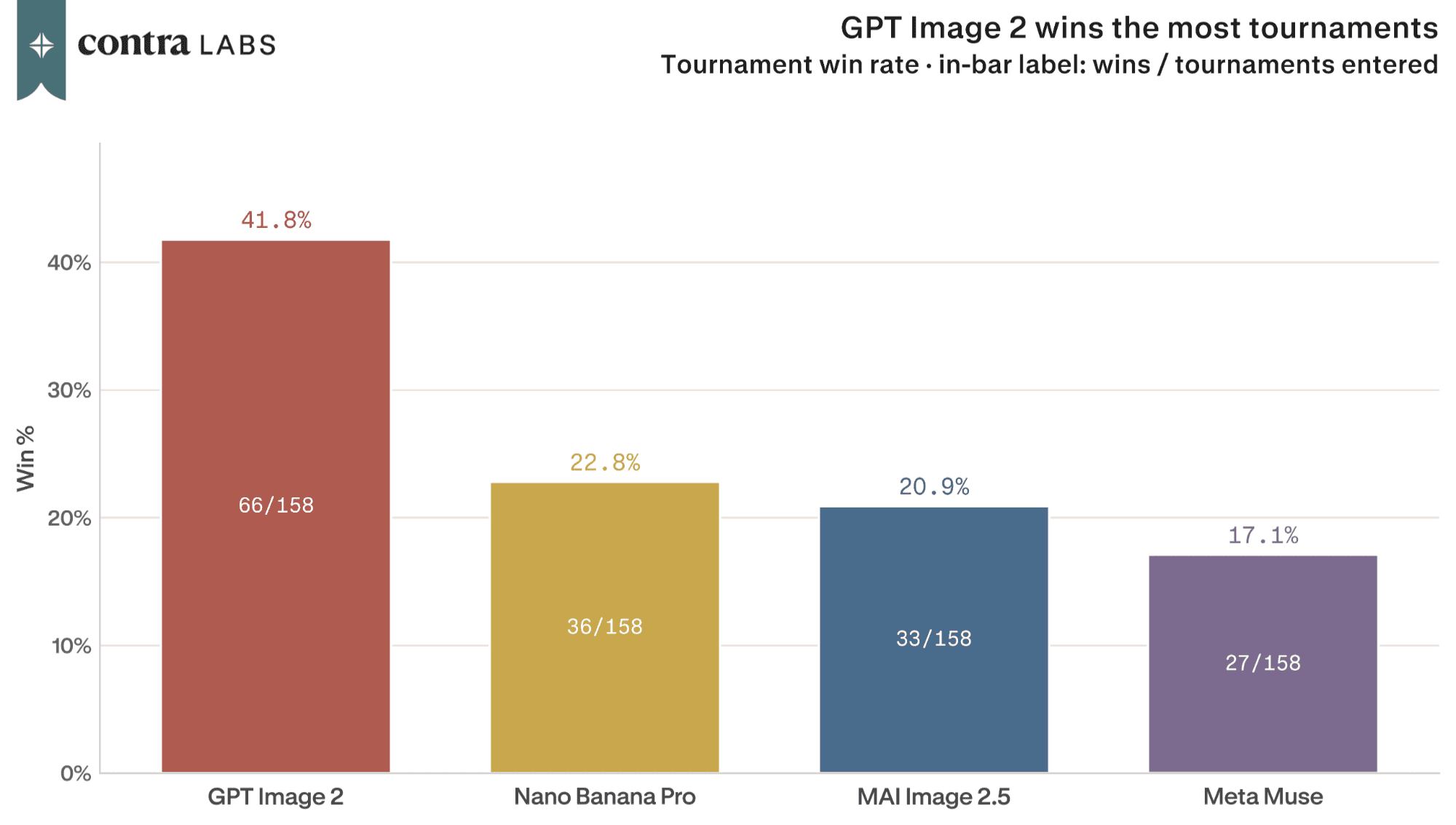
Across all tournaments, GPT Image 2 won 41.9%, far ahead of Nano Banana Pro (22.6%), MAI Image 2.5 (20.6%), and Meta Muse (17.4%). It's the only model whose win rate cleared its random-chance baseline of 25% by more than a few points.
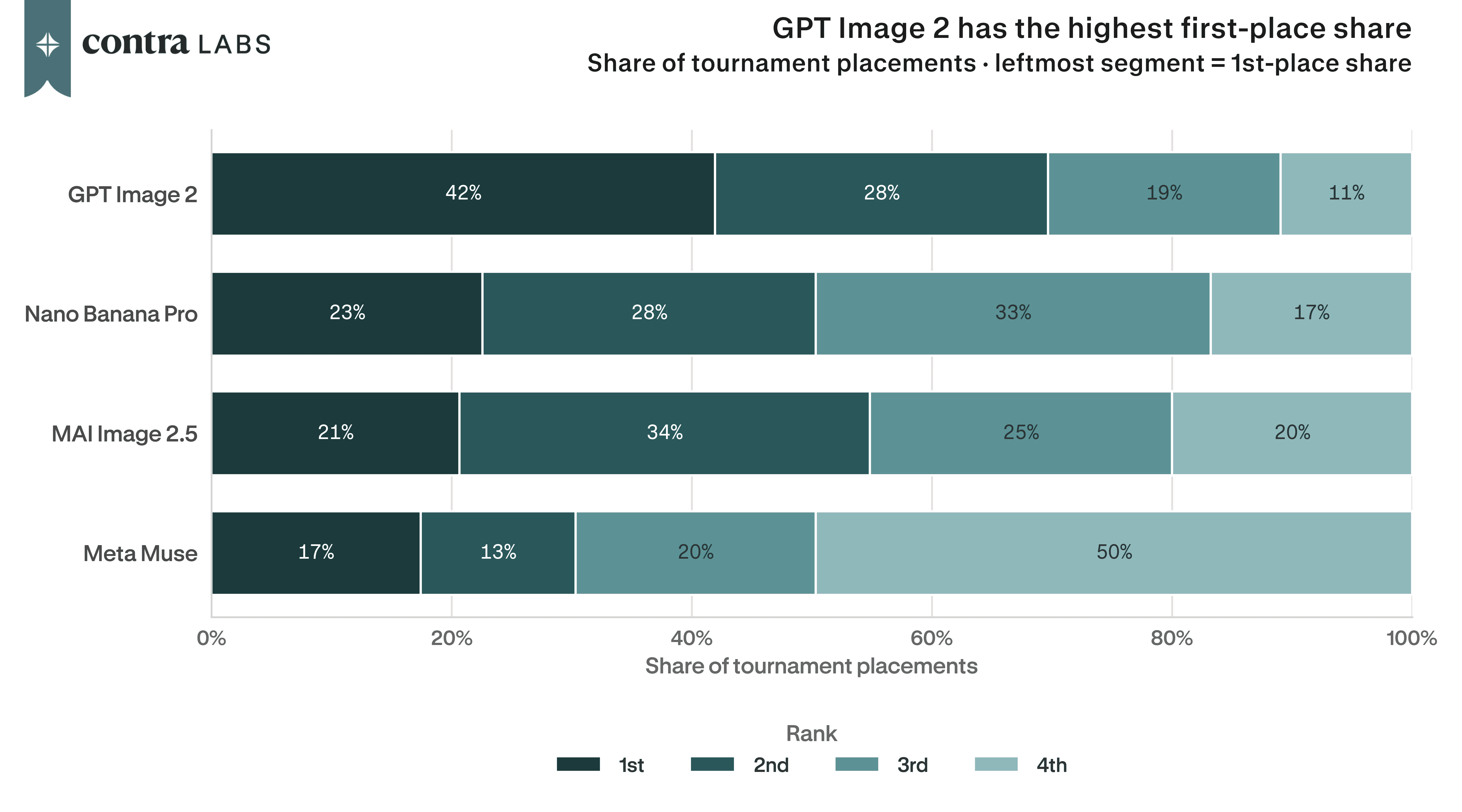
The full placement distribution shows the win is sturdy. GPT Image 2 finished first or second in 70% of tournaments and dead last in only 11%. Meta Muse shows the inverse profile: last place in 50% of tournaments.

Winning a tournament isn't the same as being client-ready
Tournament wins are relative, since someone has to come first. The binary question "Would you present this to a client?" is absolute, and no model comes out of it looking good.

GPT Image 2 was the only model to break even: 50% yes (79 of 158). Nano Banana Pro managed 32.9%, MAI Image 2.5 28.5%, and Meta Muse just 18.4%. So even the winner only produces a client-ready logo about half the time, and the other three land somewhere between 20% and a third. In practice you're still looking at every output and deciding whether it's good enough to send.

What changes when the brief looks like real client work
GPT Image 2 performs the same on both brief types. The other three don't. On the design-driven briefs, the results look like the overall numbers: GPT Image 2 around 41%, Nano Banana Pro and MAI Image 2.5 each taking about a quarter of tournaments, and Meta Muse trailing. The client briefs came out differently.

On the client briefs, 3 briefs run as 39 tournaments, GPT Image 2 stayed on top at 43.6% (17 of 39), but second place went to Meta Muse at 28.2% (11 of 39), the model that finished dead last in half of all tournaments. Given a real brief with brand context and constraints, Meta Muse beat both mid-tier models. MAI Image 2.5 meanwhile dropped to last at 12.8% (5 of 39) on exactly the briefs that most resemble paid work. Whatever Meta Muse lacks in raw rendering, it appears to recover when there's strategy to latch onto.

Treat the model as the sketchbook
So why does the brief type matter so much? Because someone still has to work out what a brand's story means for the actual logo, and for now that someone is human. In this eval, the models delivered when the brief spelled out the visual direction and guessed when it only described the company. That's the real difference between the two brief types: the design-driven briefs had that thinking already done, and the client briefs didn't. The good news is you can use the model for that thinking too, exploring directions before you commit to one.
Explore with the model
Where these models earn their keep is exploration. A generation costs seconds, so the questions a designer once answered across hours of sketching can now be answered across prompts. Run the same brief as a wordmark, a monogram, a pictorial mark, and compare. Take the strongest direction and push on its construction: heavier strokes, rounded terminals, tighter negative space, a single ink instead of a palette. Each of those terms is a lever, and the more of them a prompt names, the more control you have over what comes back. Vague prompts return the model's defaults. "Modern" is a mood rather than a typeface, and "premium" collapses into grayscale gradients. Specific prompts turn the model into a sketchbook that fills itself in.
Ask the client
Exploration still needs raw material, and it lives in the client's head:
- Scale and use context. Where the mark lives: favicon, patch, storefront, app icon. This sets legibility floors and the detail budget.
- Style references. Brands or looks they admire, translated into something named: design movements, eras, specific studios. "Swiss modernist, high contrast, geometric sans" is executable. "Modern and premium" leaves everything open.
- Brand story, audience, positioning. Context helps a model pick between two valid executions.
Converge on the prompt
Once exploration has settled the big decisions, fold them into a single brief. Lead with the execution spec, follow with references and exclusions, and brand story. Context placed before the visual direction reads as the direction, and the model paints the story instead of the mark.
The rule of thumb: if a designer could start sketching from your brief without asking follow-up questions, so can the model.
Here's what the difference looks like in practice. Both briefs below ran through all four models in the eval. The first reads like a design spec with brand context attached. The second reads like brand context with most of the spec missing.


The bottom line
GPT Image 2 is the default choice for logo work: the highest win rate, the best placement profile, a winning record against every rival, and the only model whose output clears the client-presentation bar as often as not. The one caveat is that its dominance doesn't hold across every logo style. In one, the leaderboard flips outright, which we break down in the companion piece. Meta Muse trails badly on short prompts but punches above its weight on realistic, context-rich client briefs, a hint that its failures may be partly a prompting problem.
Limitations
Because of the limited size of the dataset, we take this as directional and place more weight on patterns across briefs than on any single result. Rankings are derived from pairwise matchups, and the client-presentation question was asked per tournament, so placements, head-to-head records, and presentation rates all share the same underlying sample.
Every logo was also a one-shot generation: one prompt, one output. The results measure what each model returns on the first attempt rather than the ceiling of what it can produce with iteration, so a workflow built on regenerating and refining might clear the client-presentation bar more often than these rates suggest.
How we ran this study → Methodology