


The Frontier Design Benchmark is live.

Read on XLinkedIn

Rubric

Show scores for:

D1.1Focal point &importance-to-pro…1.1D1.1 Focal point & importance-to-prominence mappingD1.2Prominence ofprimary actions &…1.2D1.2 Prominence of primary actions & controlsD1.3Competing elements& distraction1.3D1.3 Competing elements & distractionD4.1Layout structure &grid4.1D4.1 Layout structure & gridD4.2Alignment &placement4.2D4.2 Alignment & placementD4.3Spacing & padding4.3D4.3 Spacing & paddingD4.4Density & whitespace4.4D4.4 Density & white spaceD4.5Scale & proportionof elements4.5D4.5 Scale & proportion of elementsD4.6Section order &narrative flow4.6D4.6 Section order & narrative flowD5.2Grouping &separation5.2D5.2 Grouping & separationD2.3Typeface choice &pairing2.3D2.3 Typeface choice & pairingD2.4Type scale &hierarchy2.4D2.4 Type scale & hierarchyD2.5Typesetting detail2.5D2.5 Typesetting detailD3.1Palette choice &harmony3.1D3.1 Palette choice & harmonyD3.2Colour discipline& meaning3.2D3.2 Colour discipline & meaningD6.1Consistency of thevisual system6.1D6.1 Consistency of the visual system (incl. monotony vs variety)D6.3Restraint &purposefulness of…6.3D6.3 Restraint & purposefulness of elementsD6.4Shadows, textures& decorative…6.4D6.4 Shadows, textures & decorative effectsD6.5Renderingintegrity6.5D6.5 Rendering integrity (overlap, clipping, cropping)D6.6Craft finish &refinement6.6D6.6 Craft finish & refinementD7.1Relevance &integration of…7.1D7.1 Relevance & integration of imageryD7.2Quality & craft ofimages,…7.2D7.2 Quality & craft of images, illustrations & graphicsD7.3Icon clarity &recognisability7.3D7.3 Icon clarity & recognisabilityD7.4Charts, tables &data display7.4D7.4 Charts, tables & data displayD7.5Logo & mark craft7.5D7.5 Logo & mark craftD10.1Fit to brand,product, audience…10.1D10.1 Fit to brand, product, audience & contextD8.1Presence &placement of…8.1D8.1 Presence & placement of expected controlsD8.2Interactive cues &state clarity8.2D8.2 Interactive cues & state clarityD9.1Copy quality, tone& correctness9.1D9.1 Copy quality, tone & correctnessD9.2Message clarity,ease of…9.2D9.2 Message clarity, ease of understanding & information sufficiencyD9.3Text volume &concision9.3D9.3 Text volume & concisionD9.4Contentcredibility &…9.4D9.4 Content credibility & factual coherenceD11.1Colour contrast11.1D11.1 Colour contrast (text, icons & key elements)D11.2Readable text size11.2D11.2 Readable text sizeD11.3Touch target size& spacing11.3D11.3 Touch target size & spacingHierarchy &emphasisD1D1 Hierarchy & emphasisComposition & layoutD4D4 Composition & layoutTypographyD2D2 TypographyColourD3D3 ColourConsistency & polishD6D6 Consistency & polishImagery, icons &graphicsD7D7 Imagery, icons & graphicsBrand fit &expressionD10D10 Brand fit & expressionUsability &affordanceD8D8 Usability & affordanceContent & copyD9D9 Content & copyAccessibilityD11D11 AccessibilityStructureStructureVisual craftVisual craftContent & useContent & use 35 Aspects
  • Validated with designer critiques
  • Reviewed by designers

Our benchmark reports a combination of three evaluation metrics: expert pairwise preference, the Design Critique Rubric, and an AI Slop Detector. The leaderboard ranks the models by expert preference. This page covers the other two.

Design Critique Rubric

Just an Elo score doesn’t tell you anything about how to improve the model. We acknowledge that there are design principles all good designs follow.

In Frontier Design, we curated a list of 35 high quality design rubrics based on widely acknowledged design principles. These design rubrics capture common design mistakes such as using too many fonts or spacing inconsistencies. Grading the design outputs on these rubrics can establish a baseline of design without mistakes. The rubric wheel groups them into three areas: structure, visual craft, and content and use.

The rubric was developed based on designers’ critique on the Human Creativity Benchmark. We tested the rubric’s judgments against what designers say about the same pages. Where designers had left written critiques, we compared the issues the rubric raises with the issues designers raise. Designers also reviewed the rubric’s critiques one by one, with decoy critiques mixed in.

The design rubric ranks the models much the way designers do. In our analysis, the results of our design rubrics against AI model outputs have a high correlation with the pairwise ranking of models (r = 0.94, Spearman 0.95).

10001100120013001400150016001700180019002000 405060708090 Design Critique Rubric score (0 to 100) Elo rating r = 0.94

Slop Detector / AI Slop Patterns

As part of the Frontier Design benchmark, our research team used statistical analysis on AI model outputs to create an internal Slop Detector engine that identifies AI model signs and tells. We supplemented this engine with a hand-curated AI slop pattern list that our design team has curated over time. As a result, when using our Slop Detector to score a website, we can receive an AI-likelihood score, as well as all design details that support the score.

The meter reads a few hundred features of a design, in 18 dimensions, and indicates how close the design is to AI-made websites. The AI slop patterns sit in four of the visual dimensions, marked below.

Visual

  • Colour and surfaces19
  • Typography24
  • Labels, numbering and emphasis24
  • Repeated components23
  • Shapes, cards and decoration28
  • Layout29
  • Data displays27

Content and writing

  • Audience20
  • Value25
  • Offer17
  • Explanation29
  • Proof27
  • Opening30
  • Section order25
  • Navigation33
  • Calls to action31
  • Copy26
  • Voice27

Holds AI slop patternsNumbers are features per dimension
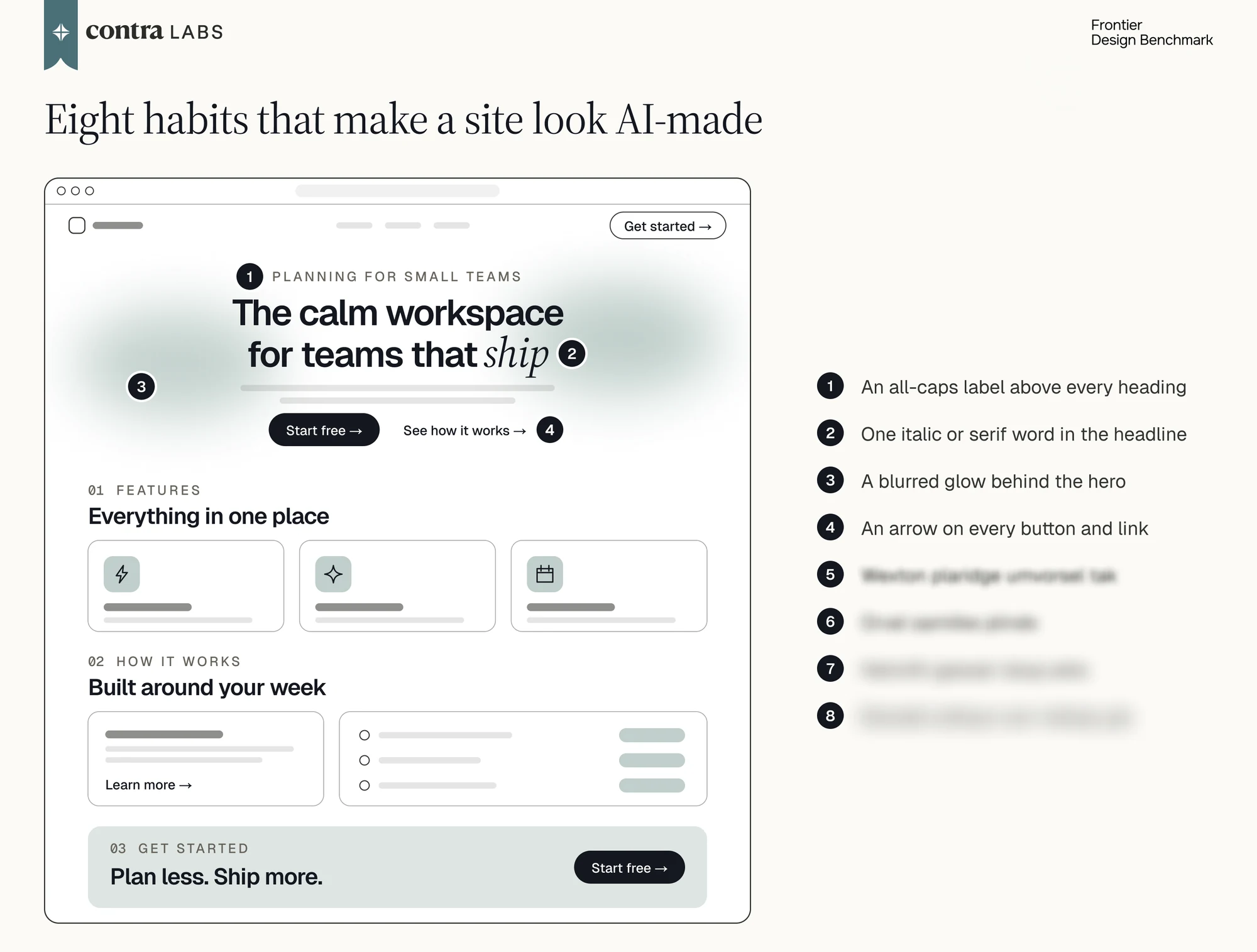
A mock landing page marked with eight habits that make a site look AI-made. Four are named: an all-caps label above every heading, one italic or serif word in the headline, a blurred glow behind the hero, and an arrow on every button and link. The other four are blurred out.

The Slop Detector tells human work apart from model work, and it picks up each model’s quirks. On a 0 to 100 scale, the human golden designs read 0.9 and the models read from 1.2 to 66.

Contra LabsFrontier Design Benchmark
0 to 100. Lower looks less AI-made.
32 · avg
  1. Human golden
  2. Gestalt
  3. DeepSeek V4 Pro
  4. Kimi K3
  5. GLM-5.3 Prime
  6. Grok 4.7
  7. Claude Fable 5.2
  8. Claude Opus 5.5
  9. Qwen3.8 Max
  10. Muse Wonder
  11. Muse Spark 1.3
  12. Claude Sonnet 5.5
  13. GPT-6 Astra
  14. GPT-6.1 Sol
  15. Gemini 4 Carbon
  16. Gemini 4 Argon
  17. Kimi K3.1 Pro

DeepSeek V4 Pro reads as low as the human reference because many of its pages are unfinished: they look unlike a typical AI-made page, not more like a human-made one.

Sign inGet in touch